Wildlife in Muir Woods
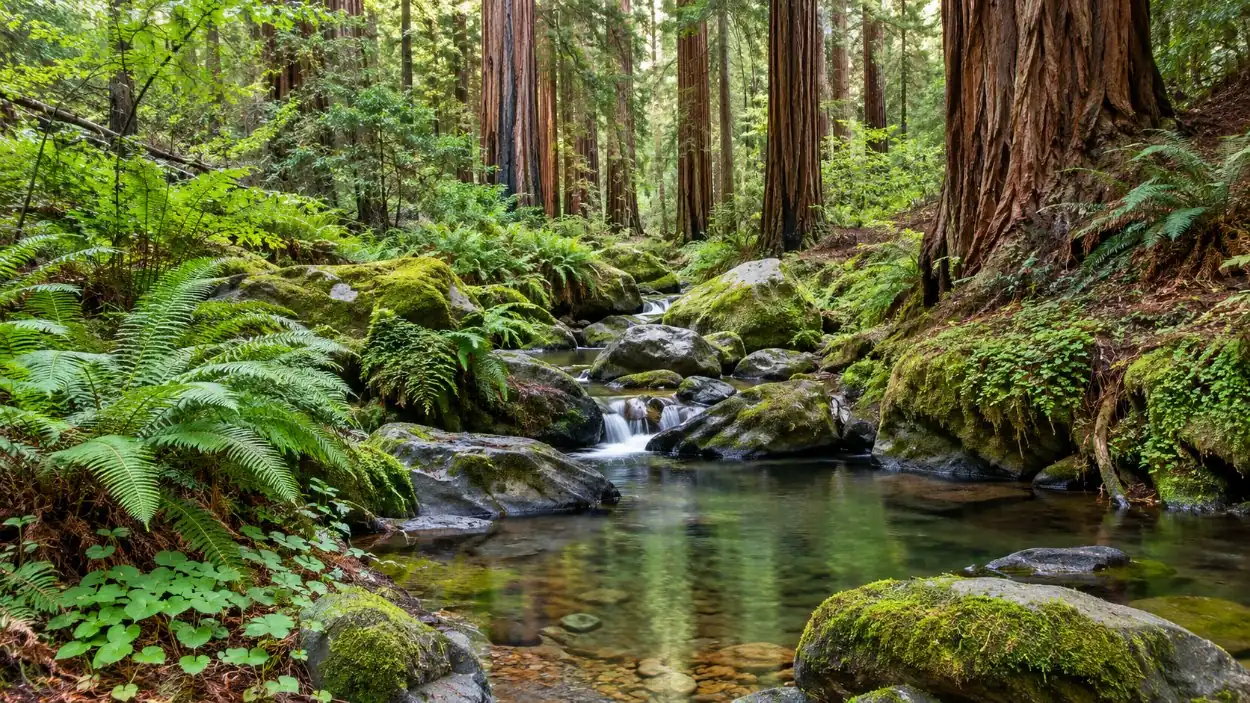
What lives in the forest
Birds. More than 50 bird species live in the monument, and northern spotted owls nest in the forest.
Bats. Eleven bat species live in Muir Woods. The monument closes at sunset and is day use only.
Mammals. Black-tailed deer, chipmunks and squirrels live in the forest and along the creek.
Banana slugs. Found on damp trails, and easy to miss underfoot. The page on Muir Woods with children has more for families.
Salmon and steelhead
After the first heavy winter rains, roughly December to February, coho salmon and steelhead trout come up Redwood Creek to spawn. The creek holds one of the few wild coho runs near a city in the United States. They are watched from the footbridges on the Main Trail; nobody enters the creek. The Dipsea footbridge over Redwood Creek is removed for the season, which is why the winter route of the Ben Johnson loop is longer. The salmon page explains what to look for.
Bears and mountain lions
Marin County has no resident bear population, so there are no bears in Muir Woods. The bears page answers the question directly. Mountain lions live in the wider Mount Tamalpais area, but the National Park Service reports none in Muir Woods itself. Hikers on the long routes into the state park are in their range; the Mount Tamalpais hikes page covers those trails.
The small hazards
- Yellow jackets. The National Park Service names them as the most dangerous animal in the park.
- Ticks. Found on the longer trails, and they can carry Lyme disease. Long trousers and a check after the hike help.
- Poison oak and stinging nettle. Plants, not animals, but they grow beside the trails and are the reason to stay on the path. Poison oak and ticks are common on the Redwood Creek Trail to Muir Beach.
Viewing etiquette
The rules of the monument protect the animals too. Visitors stay on the trails, take nothing away and leave no food behind; eating is limited to the entrance plaza and the café patio. Pets are not allowed, only working service animals, so nothing chases the deer. Salmon are watched from the bridges, never from the water. In Cathedral Grove, a signposted quiet zone, voices are lowered, and birds and running water are easier to hear there. The flat Main Trail along the creek is where most animals are seen, so the time on a tour is enough for it.
With a guide
On the half-day trip the guide leads a walk in the forest and leaves time to explore alone, and Natalie, on that tour, liked exploring at her own pace. The small-group tour gives 80 minutes on the ground and the ferry-option tour 90, both enough for the creekside loops where the salmon are watched in winter. Sarah, on the half-day trip, mentioned the guide’s talk on conservation. The private Jeep tour adds the Muir Beach Overlook, with views over the Pacific, and the Marin Headlands on the way.
A slow walk along the creek on the Bridge 3 loop sees more than a fast one on the Hillside Trail: deer, slugs and, in winter, salmon all stay close to the valley floor.
Frequently asked questions
What animals live in Muir Woods?
More than 50 bird species, 11 bat species, northern spotted owls, black-tailed deer, chipmunks, squirrels, banana slugs, and salmon in winter. The salmon page covers the fish.
Are there bears in Muir Woods?
No. Marin County has no resident bear population. The bears page answers it in full.
Are there mountain lions in Muir Woods?
They live in the surrounding Mount Tamalpais area but are not reported in Muir Woods itself, according to the National Park Service.
What is the most dangerous animal in Muir Woods?
Yellow jackets, according to the National Park Service. Ticks are found on the longer trails; the things to know page covers hazards.